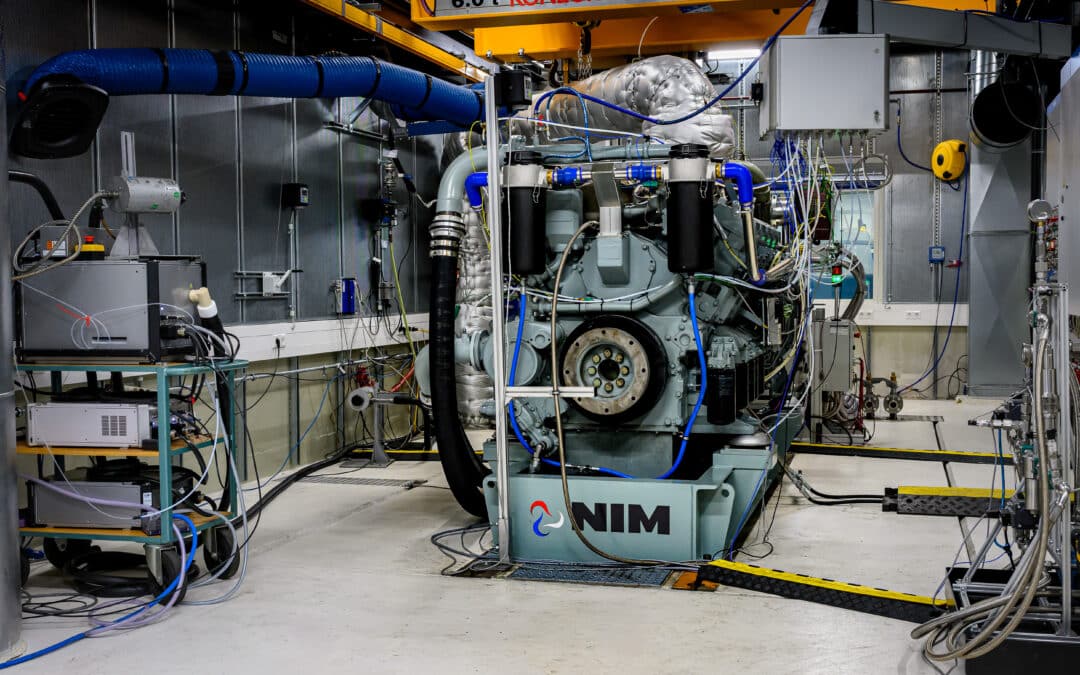
After months of development, construction, and scaling up, NIM’s methanol project is reaching another key phase. Validation of the dual-fuel methanol engine will take center stage in September.
In August, the focus was on preparations for certification and the associated requirements. Attention is now shifting to demonstrating the performance of the developed technology. This validation is taking place at TNO and forms the technical foundation for the subsequent certification process; after all, while a technical concept may work well on paper, the way the various systems behave in combination must ultimately be verified in practice.
Validation thus forms an important link between development, certification, and future application in the maritime sector.
From development to demonstrable performance
During the earlier phases of the project, various components were developed and integrated—ranging from the methanol fuel system and injection technology to engine control, monitoring, and safety features.
Validation centers on the question of whether these systems function together as intended during the development process.
This approach does not focus on just a single component; the interaction between the various components is precisely what matters. After all, a dual-fuel methanol engine must be able to operate reliably, controllably, and safely as a complete system.
By systematically testing the technology at TNO and documenting the results, a growing understanding of the complete engine configuration's operation is being gained. Moreover, these measurement and test results provide a crucial foundation for the subsequent steps in the certification process.
Performance, reliability, and safety
Various aspects are important during the validation phase. For instance, the operation of the dual-fuel configuration, the engine control system, and the way the different systems interact with one another are examined.
Performance and emissions are also key areas of focus. The data collected can be used to further optimize the engine and evaluate technical choices made during earlier development phases.
In addition, safety remains an essential part of the process. Methanol has different properties than conventional marine fuels and therefore requires specific provisions. The operation of safety functions, monitoring, and control systems must consequently be part of the assessment of the overall system.
Validation therefore goes beyond simply determining whether a motor is running. It involves gathering substantiated information on how the technology behaves.
Data as a basis for further development
The information collected during testing plays an important role in the further development of the dual-fuel methanol engine.
Measurement data provide insight into engine performance while simultaneously revealing areas where further optimization is possible. Based on this, settings can be refined, components fine-tuned, or technical solutions re-evaluated, for example.
That makes validation not an endpoint, but rather part of a continuous development process.
Moreover, the knowledge gained in this process is important for the further scaling up of the technology. NIM is not merely developing a solution for a single specific engine configuration; rather, it is working on a universal kit that can ultimately be installed on various engine types. This creates a concept with the potential for broader application within the maritime sector.
Knowledge and expertise come together.
Collaboration remains a key component of the methanol project during this phase as well. Developing new dual-fuel technology requires expertise from various disciplines.
Validation is being carried out at TNO. In addition, within the project, NIM is collaborating with partners including Delft University of Technology, the University of Twente, RINA, Lloyd’s Register, Olthof, Dolderman, Oechies, De Ruyter, and Marine Service Noord.
The knowledge collectively built up during earlier development phases comes together in the validation phase. Engineering, software, engine development, safety, and expertise in maritime applications must ultimately result in a single integrated system.
Moreover, many of these partners are linked to NIM as shareholders. Consequently, collaboration forms the foundation not only of the development project but also of the broader ambition to accelerate innovation within the Dutch maritime sector.
Another step forward from Metha-Start to Metha-Max
With the validation phase, further progress is being made on the roadmap from Metha-Start to Metha-Max.
The earlier phases focused on developing the technology, integrating the various systems, and scaling up to larger engine configurations. Now, it is becoming increasingly important to demonstrate the technology's performance.
The insights gained during the validation phase thus provide important input for the further optimization of the concept and the subsequent steps towards practical application.
Step by step, this process yields not only a technically functional dual-fuel methanol solution but also the knowledge and supporting evidence required for certification and broader application. Furthermore, by developing a universal kit compatible with multiple engine types, NIM is working towards a solution that is reliable, scalable, and capable of wider deployment within the maritime sector.
Outlook for October 2026
In October, we will take the next step in the methanol project. We will then delve further into the results and insights from the development and validation process, and what these mean for the continued development towards Metha-Max.